Introduction
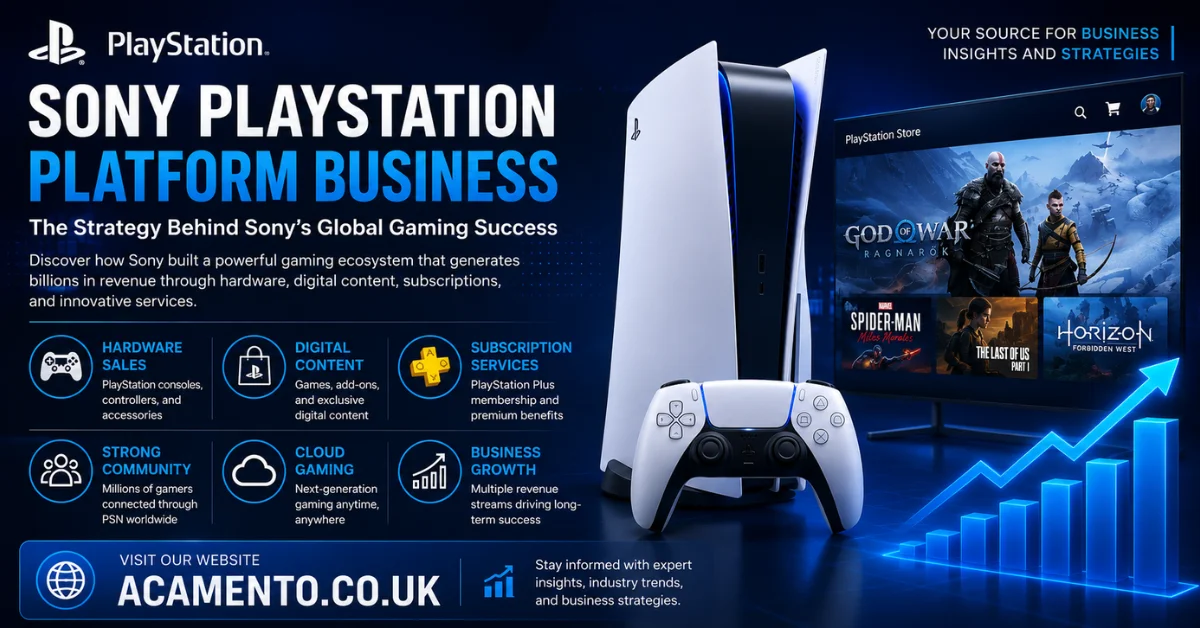
The Sony PlayStation platform business is widely recognized as one of the most successful platform-based business models in the entertainment and technology industries. Over the past three decades, Sony has transformed PlayStation from a simple gaming console into a powerful digital ecosystem that serves millions of users worldwide.
Today, PlayStation is not just a gaming device. It is a complete entertainment platform that connects gamers, developers, publishers, content creators, advertisers, and subscription services under one ecosystem. This transformation has enabled Sony to generate billions of dollars in annual revenue while maintaining a loyal global customer base.
The modern sony playstation platform business ps5 strategy focuses on hardware innovation, digital content distribution, subscription services, cloud gaming, and exclusive entertainment experiences. Through these initiatives, Sony continues to strengthen its position as one of the leading companies in the gaming industry.
This article explores the business model, revenue streams, growth strategies, competitive advantages, challenges, and future opportunities that define the Sony PlayStation platform business.
What Is the Sony PlayStation Platform Business?
The Sony PlayStation platform business is a digital platform model that creates value by connecting different groups of users within a single ecosystem. Unlike traditional businesses that rely solely on product sales, Sony generates revenue from multiple interconnected sources.
At the center of the PlayStation ecosystem is the gamer. However, Sony also creates value for game developers, publishers, subscription providers, advertisers, and technology partners.
The PlayStation platform consists of several core components:
- PlayStation gaming consoles
- PlayStation Network (PSN)
- PlayStation Store
- PlayStation Plus subscriptions
- First-party game studios
- Third-party publishing partners
- Cloud gaming services
- Virtual reality technology
Together, these components create a powerful ecosystem that generates recurring revenue and encourages long-term customer engagement.
The History and Evolution of the Sony PlayStation Platform Business
The Launch of the Original PlayStation
Sony entered the gaming market in 1994 with the release of the original PlayStation console. At the time, Nintendo and Sega were dominant players in the industry. Despite intense competition, Sony successfully differentiated itself through advanced technology, strong developer support, and aggressive marketing strategies.
The original PlayStation quickly became a commercial success, selling over 100 million units worldwide. This achievement established Sony as a major force in the gaming industry and laid the foundation for the future PlayStation ecosystem.
Sony’s early success demonstrated the importance of combining innovative hardware with a strong software library. By attracting leading game developers and publishers, Sony created a platform that appealed to both gamers and businesses.
PlayStation 2 and Business Expansion
The release of PlayStation 2 marked a significant milestone in the growth of the Sony PlayStation platform business.
The PS2 was more than just a gaming console. It also functioned as a DVD player, making it an attractive entertainment device for households worldwide. This dual functionality helped Sony reach a broader audience and increase hardware sales.
The PlayStation 2 became the best-selling gaming console in history, with more than 155 million units sold globally. During this era, Sony strengthened relationships with developers and expanded its influence in the entertainment market.
The success of PS2 demonstrated how a platform business can create value beyond its core product.
The Digital Transformation Era
As internet connectivity became more common, Sony shifted its focus toward digital services.
The PlayStation 3 introduced online gaming capabilities and digital content distribution. Although the PS3 faced challenges during its early years, it helped Sony establish the foundation for its future digital ecosystem.
With PlayStation 4, Sony accelerated its digital transformation strategy by focusing on:
- Digital game downloads
- Online multiplayer gaming
- Subscription services
- Social gaming features
- Digital entertainment platforms
This shift significantly increased recurring revenue opportunities and reduced Sony’s dependence on physical game sales.
The Business Model Behind Sony PlayStation
Platform-Based Revenue Generation
One of the biggest strengths of the Sony PlayStation platform business is its ability to generate revenue from multiple sources.
Unlike traditional product businesses that rely primarily on one-time sales, Sony benefits from continuous user engagement across various services.
The company’s business model includes:
Hardware Revenue
Sony earns revenue from the sale of:
- PlayStation consoles
- Controllers
- Gaming accessories
- Virtual reality devices
- Headsets and peripherals
Although hardware profit margins can be relatively low initially, these products serve as entry points into the broader PlayStation ecosystem.
Once consumers purchase a PlayStation console, they are likely to spend money on games, subscriptions, and digital content for years.
Software Revenue
Software sales represent one of Sony’s most profitable business segments.
Revenue sources include:
- Digital game downloads
- Physical game sales
- Expansion packs
- Downloadable content (DLC)
- Premium editions
The PlayStation Store has become a major driver of software revenue, allowing Sony to distribute content globally without manufacturing or shipping costs.
Subscription Services
Subscription revenue plays an increasingly important role in the sony playstation platform business ps5 strategy.
PlayStation Plus offers several membership tiers that provide:
- Online multiplayer access
- Monthly games
- Exclusive discounts
- Cloud storage
- Extensive game libraries
Subscriptions create predictable recurring revenue while increasing customer retention and platform loyalty.
Sony PlayStation Platform Business PS5 Strategy
The PS5 as a Platform Growth Engine
The launch of PlayStation 5 represented more than a hardware upgrade. It was a strategic business move designed to expand Sony’s digital ecosystem.
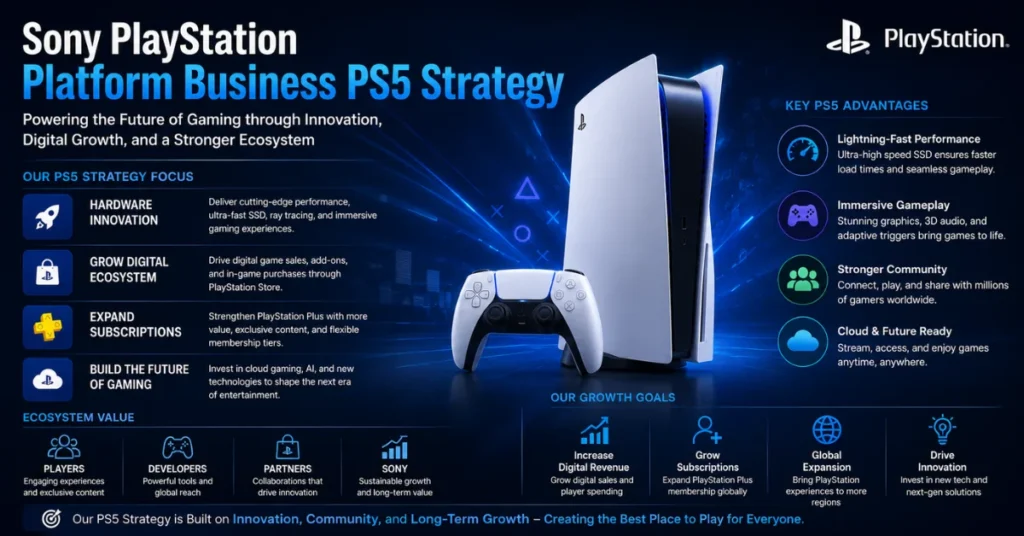
The sony playstation platform business ps5 strategy focuses on increasing user engagement while driving digital spending.
Key PS5 features include:
- Ultra-fast SSD technology
- Advanced graphics performance
- Immersive gaming experiences
- Enhanced online functionality
- Improved content delivery systems
These innovations help Sony maintain its competitive advantage in an increasingly crowded gaming market.
Expanding Digital Revenue
A major objective of the PS5 strategy is to encourage users to purchase content digitally.
Digital distribution provides several benefits:
- Higher profit margins
- Lower production costs
- Instant content delivery
- Better customer convenience
As digital purchases continue to grow, Sony can improve profitability while delivering a better user experience.
Strengthening the Subscription Economy
The future of gaming increasingly revolves around subscriptions.
Sony has invested heavily in expanding PlayStation Plus to compete with subscription-based gaming services offered by competitors.
By offering access to hundreds of games through subscription packages, Sony creates long-term relationships with customers and generates stable recurring revenue.
Competitive Advantages of the Sony PlayStation Platform Business
Powerful Brand Loyalty
Few gaming brands have the same level of recognition as PlayStation.
Over the years, Sony has built trust through:
- Consistent innovation
- High-quality gaming experiences
- Reliable hardware
- Strong customer support
This brand loyalty makes customer retention easier and reduces marketing costs.
Exclusive Content Strategy
Exclusive games remain one of Sony’s most valuable competitive assets.
Popular franchises such as:
- God of War
- Marvel’s Spider-Man
- Horizon
- The Last of Us
- Gran Turismo
attract millions of gamers and encourage consumers to choose PlayStation over competing platforms.
Exclusive content not only drives console sales but also strengthens the overall ecosystem.
Strong Developer Partnerships
The success of the Sony PlayStation platform business depends heavily on its relationships with developers and publishers.
Sony provides developers with:
- Access to a large user base
- Development tools
- Marketing support
- Revenue-sharing opportunities
These partnerships ensure a continuous stream of high-quality content for PlayStation users.
The Role of Network Effects in Sony’s Success
One of the key principles behind platform businesses is the concept of network effects.
A network effect occurs when a product or service becomes more valuable as more people use it.
For PlayStation:
- More gamers attract more developers.
- More developers create more games.
- More games attract more gamers.
- Increased activity strengthens the ecosystem.
This self-reinforcing cycle helps Sony maintain long-term growth and competitive advantages.
Challenges Facing the Sony PlayStation Platform Business
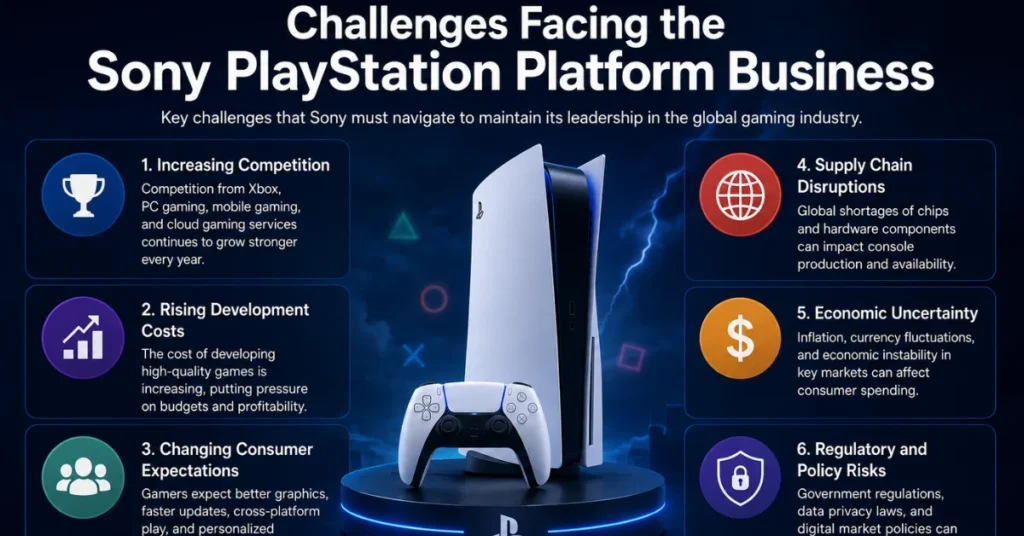
Despite its success, Sony faces several challenges.
Growing Industry Competition
The gaming industry has become increasingly competitive.
Sony competes with:
- Microsoft Xbox
- PC gaming platforms
- Mobile gaming companies
- Cloud gaming services
To maintain leadership, Sony must continue investing in innovation and customer experience.
Rising Development Costs
Modern video game development requires substantial investments.
Major challenges include:
- Larger development teams
- Higher production budgets
- Increased marketing expenses
- Longer development timelines
Sony must balance creativity, quality, and profitability to remain competitive.
Changing Consumer Expectations
Today’s gamers expect:
- Faster content delivery
- Cross-platform experiences
- Cloud gaming access
- Continuous updates
Meeting these expectations requires ongoing investment in technology and infrastructure.
Future Growth Opportunities
Cloud Gaming
Cloud gaming has the potential to reshape the gaming industry.
Benefits include:
- No expensive hardware requirements
- Instant game access
- Global scalability
- Subscription-based revenue opportunities
Sony continues to invest in cloud technology as part of its long-term growth strategy.
Artificial Intelligence
Artificial intelligence is expected to play an important role in future gaming experiences.
Potential applications include:
- Personalized recommendations
- Advanced game development tools
- Improved customer support
- Enhanced user experiences
AI could help Sony increase efficiency while improving player satisfaction.
Virtual Reality and Immersive Experiences
Virtual reality represents another major growth opportunity.
With PlayStation VR technology, Sony can create entirely new entertainment experiences that attract both gamers and non-gaming audiences.
As VR technology becomes more affordable and accessible, it could become a significant revenue source for the PlayStation ecosystem.
Conclusion
The Sony PlayStation platform business is a remarkable example of how a company can transform a gaming console into a global digital ecosystem. Through hardware innovation, digital content distribution, subscription services, exclusive games, and strategic partnerships, Sony has built one of the most successful platform businesses in the world.
The ongoing sony playstation platform business ps5 strategy highlights Sony’s commitment to long-term growth through digital transformation, cloud gaming, subscription services, and immersive technologies. By continuously evolving its ecosystem and responding to changing consumer demands, Sony remains well-positioned to lead the gaming industry for years to come.
As the gaming market continues to expand, the Sony PlayStation platform business will likely remain a powerful case study in platform economics, customer engagement, and sustainable business growth.
FAQ’s
1. What is the Sony PlayStation platform business?
The Sony PlayStation platform business is a digital ecosystem that connects gamers, developers, publishers, subscription services, and other technology partners through PlayStation consoles and digital services.
2. How does Sony PlayStation make money?
Sony generates revenue through multiple sources, including PlayStation consoles, games, downloadable content, PlayStation Store purchases, PlayStation Plus subscriptions, accessories, and virtual reality products.
3. What is the Sony PlayStation platform business PS5 strategy?
The PS5 strategy focuses on growing Sony’s digital ecosystem through hardware innovation, digital game distribution, subscriptions, online services, and increased user engagement.
4. Why is the PS5 important to Sony’s business strategy?
The PS5 acts as an entry point into Sony’s wider ecosystem. After purchasing a console, users can spend on digital games, subscriptions, downloadable content, accessories, and other PlayStation services.
5. How does PlayStation Plus contribute to Sony’s business?
PlayStation Plus provides recurring subscription revenue while offering users benefits such as online multiplayer, monthly games, discounts, cloud storage, and access to game libraries.
6. What are Sony PlayStation’s main competitive advantages?
Key advantages include strong brand loyalty, exclusive game franchises, reliable hardware, a large user base, strong developer relationships, and a broad digital ecosystem.